
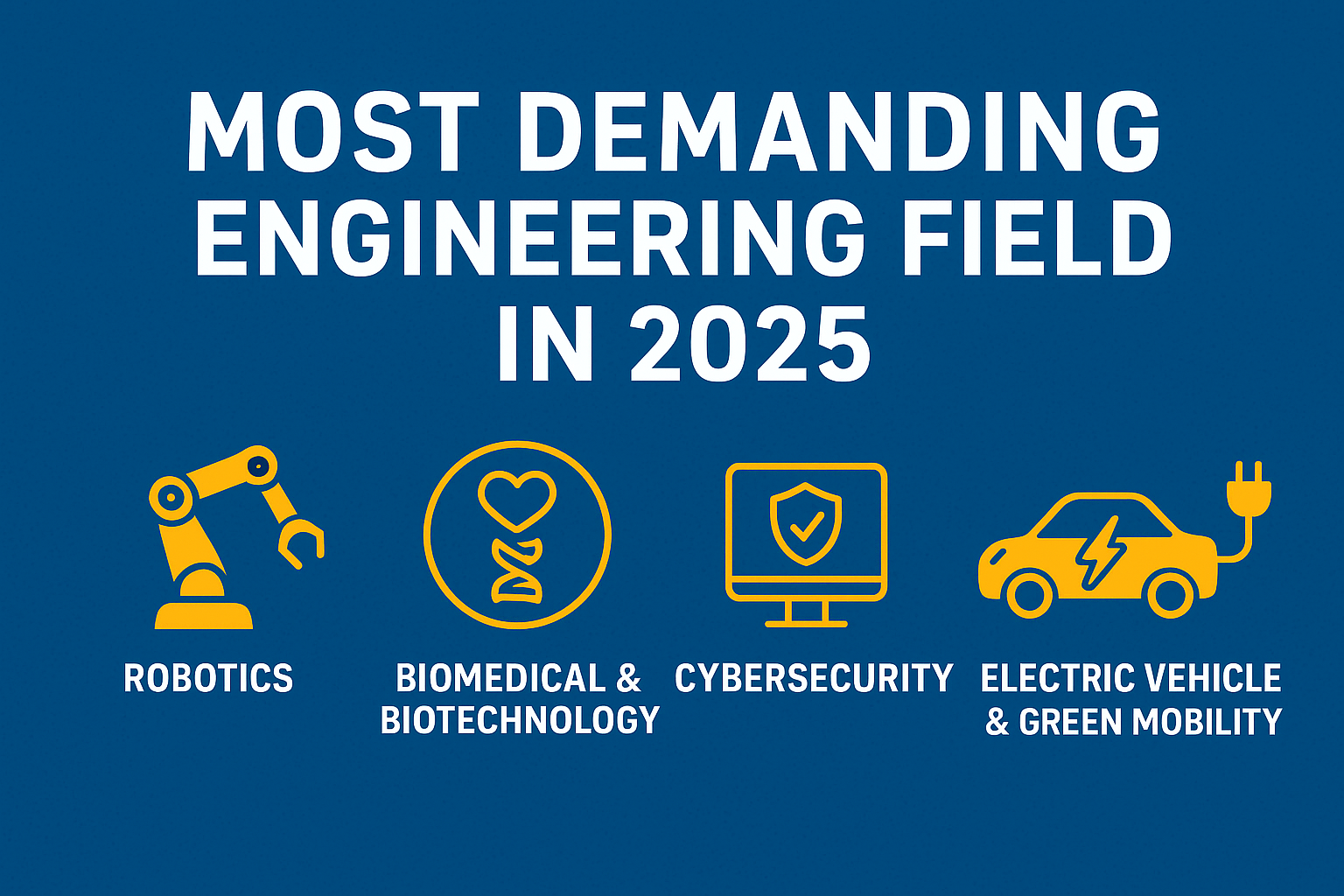
Engineering evolves rapidly as new-age technologies and processes are being implemented in industries. In 2025, innovative engineers will be sought after to solve complex problems. Global markets are being run by AI, renewable energy, robotics, data science, and biotech. Updated engineers with present-day skills can multitask between several sectors for jobs. Students preparing for engineering must know which branches will prosper. This gives a professional edge in competition and shall remain future-ready. Now let’s look at the most sought engineering fields for 2025.
Robotics and Automation Engineering
Automation is driving efficiency across industries. Robotics engineers design machines for factories, warehouses and healthcare systems. Robots can do repetitive, hazardous and precision tasks better than humans. In the assembly of vehicles, the medicine-delivery systems and the operations, machines are being programmed. Automation is being adopted by industries like never before. Robotics reduces errors, costs and increases productivity. Companies worldwide are investing heavily in industrial robots. Reports predict double-digit growth in the robotics market till 2025. Such growth means job security for engineers with mechatronics skills.
Robotics engineers need skills in electronics, mechanics and software design. Knowledge of control systems and embedded programming is crucial. Career opportunities are in aerospace, logistics, healthcare and consumer electronics. Demand for robotics professionals will only increase as industries automate more. Students entering this field will be part of a revolution in human productivity.
Also read: Japan and Africa Seal 300 Cooperation Agreements at TICAD9: A New Era of Partnership
Biomedical and Biotechnology Engineering
Biomedical engineers merge medicine with engineering to design health solutions. These produce prosthetics and diagnostic equipment, along with surgical instruments of the highest order. Biotechnology engineers come up with innovations in genetics, agriculture and pharmaceuticals. They are revolutionising the world of healthcare and biology. Biomedical innovations account for pacemakers, dialysis machines and systems of imaging. Engineers design and develop gadgets that can be worn to monitor health in real-time. Biotechnology works behind the scenes to advance genetic engineering and sustainable farming. Engineers ensure rapid development of vaccines, tissue engineering solutions and green-bioproducts.
Healthcare spending is increasing globally, more demand for skilled engineers. Biomedical professionals work in hospitals, research institutions and manufacturing companies.
Required skills include biology, chemistry, electrical design and programming. Engineers must also understand ethical issues and regulatory standards. Professionals who succeed here will improve the lives of millions. This field offers immense satisfaction and global recognition.
Cybersecurity
Digital transformation exposes organisations to cyber threats. Cybersecurity engineers protect systems, networks and data. They design secure architectures and monitor attacks. Their work ensures business continuity.
Cybercrime is an enormous cash drain on companies. In response, the experts-rights must place rights on firewalls, encryption, and threat detection so that these attacks can be prevented. The functioning skills they need are network security, ethical hacking, and cryptography.
Engineers must stay updated with evolving attack techniques. They design multi-layered defences to resist advanced threats.
Companies rely on such agencies to safeguard customer data and intellectual property. Information security is a rewarding career that provides very good pay and security on a long-term basis. Government agencies, financial institutions, and tech companies are aggressively filling these jobs. Students entering this field contribute to digital safety. Future societies can’t function without cybersecurity professionals.
Quantum and Advanced Emerging Engineering
Quantum engineering is the frontier of science and technology. Engineers in this field build quantum computers and sensors. These systems solve problems impossible for classical machines.
Quantum computing will bring breakthroughs in medicine, cryptography and finance. Quantum engineers design circuits using qubits instead of binary digits. They also explore secure communication through quantum encryption. Engineers in this space are at the edge of discovery.
Nanoneuronics integrates nanotech with neural science for advanced medical solutions. Such interdisciplinary areas offer opportunities for ambitious professionals.
Students in these spaces get early mover advantages. Global research institutes are actively investing in these future technologies. Engineers who commit here shape the world’s scientific future. Though challenging, the rewards include prestige, innovation and impact.
Also read: Apply for Capitec Bank Bursaries 2026 & Fund Your Studies!
Mechanical, Core and Mechatronics Engineering
Mechanical engineering remains fundamental despite newer specialisations. Engineers design machinery, engines and structural systems. This branch evolves by integrating smart technologies.
Mechatronics combines mechanical design, electronics and computer science. Engineers in this space create advanced manufacturing systems. They design automated equipment used in industries worldwide. This field bridges traditional engineering with modern automation.
Core engineering disciplines like civil and electrical still matter. Engineers build infrastructure, transportation systems and power networks. These roles ensure society functions smoothly. Students choosing core branches get stability and broad career options. Indian colleges see growth in mechanical and civil streams. Companies still hire engineers with these skills. These careers are evergreen as they are fundamental. Merging old with new creates demand.
Electric Vehicle and Green Mobility Engineering
A revolution is coming into the automotive world. In view of environmental importance, electric vehicles are getting into the world market. Engineers design batteries, motors, and charging systems for electric vehicles.
Some governments promote electric mobility with incentives and policies. Investment continues from Tesla, Tata, and Ola Electric. Engineers working in EV development have plenty of opportunities.
Green mobility includes designing charging networks, hydrogen fuel systems and hybrid vehicles. Engineers create solutions that balance performance and environmental goals. Demand for sustainable transportation ensures job stability.
Required skills include electrical systems, battery technology and power electronics. Engineers must also know energy storage and vehicle dynamics. Students entering this field are contributing to a cleaner planet. EV engineering means exciting and impactful work.
Aerospace and Space Engineering
Aerospace engineers design aircraft, spacecraft and propulsion systems. Space exploration is growing rapidly through private companies and national agencies. Engineers working here are achieving incredible things.
Commercial space travel and satellite launches are increasing the demand for specialists. Engineers are building vehicles to explore planets and beyond. They are also designing drones, missiles and navigation systems.
Required skills include aerodynamics, propulsion and materials science. Aerospace engineers are contributing to defence, communication and research. Students passionate about space have never had better opportunities.
Global interest in Mars missions and space colonisation is boosting career prospects. Engineers in this field are part of humanity’s greatest adventures. Aerospace is a prestigious and futuristic branch of engineering.
Also read: South Africa Wine Bursaries 2026 – Application Open Now
Conclusion
2025 is redefining engineering opportunities. Cybersecurity, quantum technologies and EV mobility are rising fast. Core engineering branches still have value as industries expand. Students preparing for careers should align with these growth sectors. Engineering innovates and provides solutions. Those who embrace newer technologies will have the future. Decide now and succeed later. There is an endless opportunity for the next generation in these fields, which are top engineering areas for 2025.


