
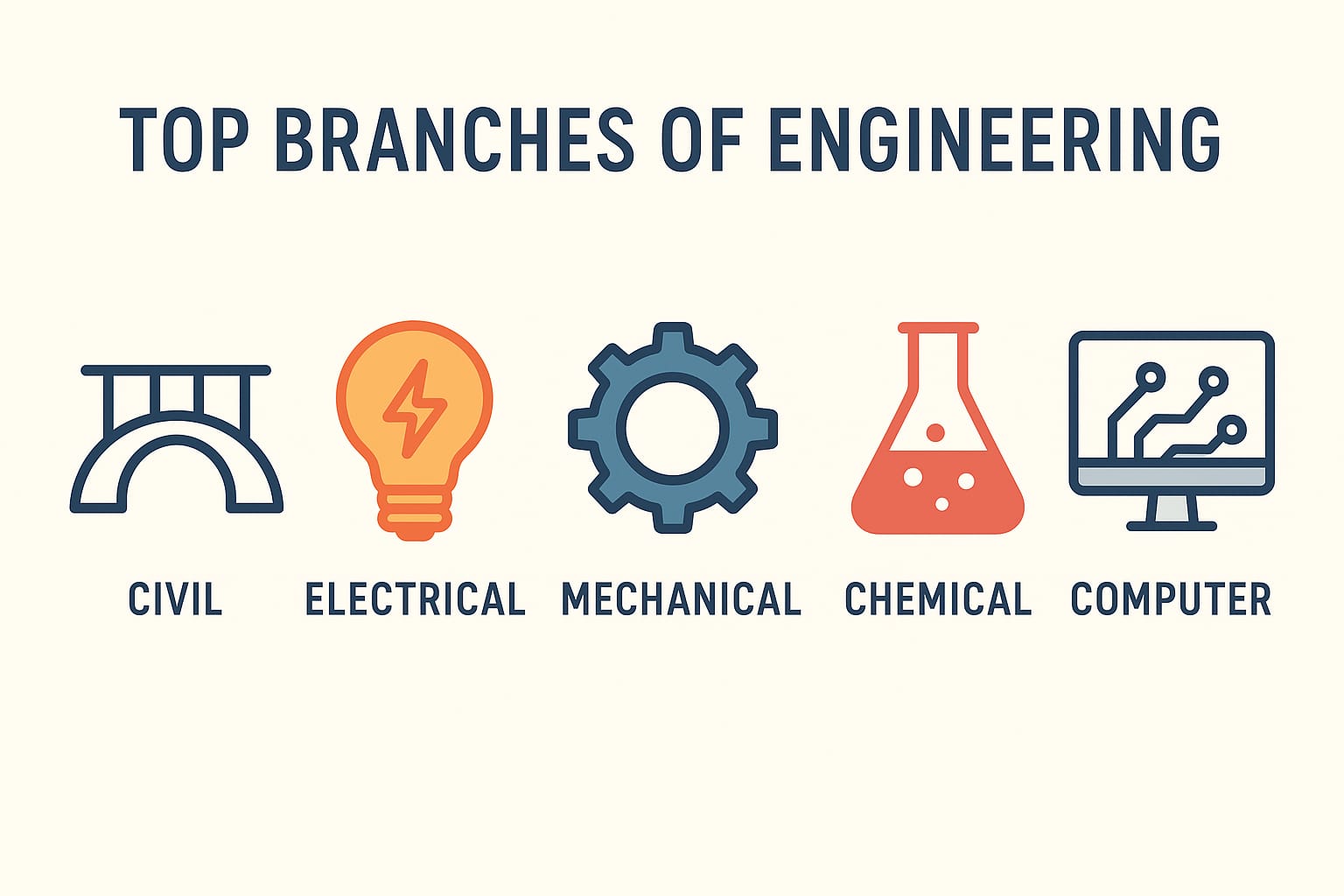
If your goal is to build a career that crosses borders, working with international teams, relocating to different countries, and contributing to projects used worldwide, the branch you choose matters. Below is a practical, guide to the top branches of engineering for global exposure, plus the skills, credentials, and job markets that make them truly international.
What “Global Exposure” Really Means?
Global exposure isn’t just about relocating. It’s about:
- Portability of skills across countries and industries
- Demand from multinational employers and cross-border projects
- Work tied to global standards (ISO, IEC, IEEE, BIM)
- Remote-first and distributed-team opportunities
- Clear pathways to international certifications and visas
Also read: Apply for Capitec Bank Bursaries 2026 & Fund Your Studies!
1) Computer Science & Engineering (CSE) / Software Engineering
Why it’s top-tier for international jobs: Software is borderless. Cloud platforms, open-source ecosystems, and distributed product teams make CSE one of the easiest pathways to engineering careers abroad and remote roles.
Global niches: Full-stack, cloud, DevOps, mobile, AI/ML, data platforms, product engineering.
Where the demand is: US, Canada, EU, UK, Singapore, Australia, UAE, plus remote roles from anywhere.
Boost your mobility: Contribute to open-source, master one cloud (AWS/Azure/GCP), build a portfolio on GitHub, and learn product communication skills.
Keywords to note: best engineering branches for international jobs, global demand engineering fields.
2) Data Science & AI/ML Engineering
Why it travels well: Every region is building AI capability, healthcare analytics, fintech, retail, manufacturing, climate tech. Data governance differs by country, but the core math, algorithms, and MLOps workflows are universal.
Global niches: NLP, computer vision, recommender systems, MLOps, LLM apps, analytics engineering.
Where the demand is: North America, Western Europe, Middle East hubs, and APAC tech centers.
Credentials that help: Strong math/stats, Kaggle/competitions, papers or blogs, certifications in cloud data stacks.
3) Cybersecurity Engineering
Why it’s border-agnostic: Threats are global, and security frameworks (NIST, ISO 27001, SOC 2) are internationally recognized. Many roles allow hybrid or remote work with cross-border clients.
Global niches: Security engineering, AppSec, cloud security, threat hunting, incident response, GRC.
What to add: Certifications (CompTIA Security+, CISSP, CEH), bug bounty track record, secure coding skills.
4) Electrical & Electronics Engineering (EEE)
Why it scales globally: From semiconductors to power systems, electronics standards travel well (IEC, IEEE). The energy transition and electrification wave amplify cross-border projects.
Global niches: Embedded systems, power electronics, VLSI design, grid modernization, EV/charging infrastructure.
Where the demand is: US, EU (Germany/Netherlands), East Asia (Japan/Korea/Taiwan), Middle East for power projects.
Edge for mobility: Learn PCB/EDA tools, IEC/IEEE standards, and safety frameworks; pair with firmware/software for mechatronics roles.
5) Mechanical, Mechatronics & Robotics
Why it’s international: These fields sit at the heart of global manufacturing, automation, and advanced robotics, industries dominated by multinationals.
Global niches: CAD/CAE, industrial automation, robotics integration, HVAC, additive manufacturing.
Where the demand is: Germany, US, Japan, South Korea, Singapore, and emerging robotics hubs.
Level-up: Get fluent with SolidWorks/ANSYS, PLCs, ROS, and reliability engineering; show factory-scale project experience.
6) Civil & Structural (with BIM & Sustainability)
Why it’s globally relevant: Infrastructure is a universal need. Mastering BIM (Building Information Modeling), green building codes, and seismic standards opens doors to international contractors and consultancies.
Global niches: BIM coordination, transport infrastructure, high-rise design, sustainable materials, project controls.
Where the demand is: GCC, Southeast Asia, Africa, and ongoing upgrades in developed markets.
What to add: BIM (Revit, Navisworks), exposure to FIDIC contracts, LEED/BREEAM knowledge, and construction safety norms.
Also read : South Africa Wine Bursaries 2026 – Application Open Now
7) Chemical & Process Engineering (Energy Transition)
Why it travels: Process engineers are pivotal to clean energy, hydrogen, LNG, process optimization, and decarbonization, areas with multinational capex and mobility.
Global niches: Process design, refinery & petrochemicals, carbon capture, battery materials, green hydrogen, pharma manufacturing.
Where the demand is: Middle East, North America, EU, and APAC megaprojects.
Stand out: Aspen HYSYS/CHEMCAD proficiency, PFD/P&ID mastery, process safety (HAZOP, SIL).
8) Biomedical & Medical Devices
Why it’s cross-border: Aging populations and med-tech innovation fuel consistent demand. Regulatory pathways differ, but the core device engineering discipline is globally recognized.
Global niches: Medical devices, diagnostics, imaging, digital health, computational biology, biomechanics.
Where the demand is: US, EU med-tech clusters, UK, Singapore.
Helpful add-ons: Quality systems (ISO 13485), regulatory awareness (FDA/CE), human factors engineering.
9) Aerospace & Aeronautical
Why it’s international: Aviation, defense, and space ecosystems rely on complex global supply chains and multinational programs.
Global niches: Avionics, aerostructures, propulsion, flight software, UAV systems, satellite platforms.
Where the demand is: US, EU (France/Germany), UK, Canada; growing space startups in multiple regions.
Bonus: Get hands-on in composites, CFD, systems engineering, and safety-critical software.
10) Environmental & Sustainability Engineering
Why it’s rising: Climate commitments, ESG reporting, circular economy, and water/waste systems are creating engineering careers abroad within development banks, NGOs, and the private sector.
Global niches: Life cycle assessment (LCA), water treatment, waste-to-energy, renewable integration, environmental compliance.
Where the demand is: EU, North America, GCC (water/desal), developing regions via international projects.
Add this: GIS, LCA tools, carbon accounting, and policy literacy.
11) Industrial & Systems Engineering (Operations + Analytics)
Why it travels: Multinationals need engineers who optimize global supply chains, quality, and operations.
Global niches: Supply chain design, operations research, quality, logistics tech, manufacturing analytics.
Where the demand is: Everywhere with large manufacturing/retail/logistics footprints.
Edge: Six Sigma/Lean, simulation tools, SQL/Python for ops analytics, ERP familiarity.
Skills & Credentials That Supercharge Mobility
- Standards fluency: ISO, IEC, IEEE, ASME, BIM, safety (SIL/IEC 61508).
- Cloud & data stack: Even for non-software branches, data literacy (Python, SQL) and cloud basics help.
- Certifications that map globally: PMP/PRINCE2 (project), LEED/BREEAM (sustainability), Security+ / CISSP (cyber), AWS/Azure/GCP (cloud).
- Portfolio > paper: Public GitHub, design portfolio, competition wins (Formula Student, Hackathons, CTFs), published case studies.
- Language & soft skills: Clear English writing, plus a second language (German, Japanese, French, Spanish) boosts employability and on-site roles.
- Mobility programs: University exchanges, international internships, remote open-source projects, and multinational grad schemes.
How to Choose the Right Branch for Global Exposure?
- Target industries first, then pick the branch that dominates them.
- Check visa-friendliness and employer sponsorship trends in your destination countries.
- Prioritize cross-disciplinary overlap (e.g., mech + embedded = robotics; civil + BIM + sustainability = global infra).
- Map your portfolio to standards used worldwide; make your work demonstrably portable.
- Stay future-proof: energy transition, AI, automation, and healthcare tech are durable global themes.
Also read: Japan and Africa Seal 300 Cooperation Agreements at TICAD9: A New Era of Partnership
FAQ
1) Which engineering branch has the highest global mobility right now?
Software (CSE) leads thanks to remote-first culture and universal tech stacks, followed closely by AI/ML and Cybersecurity.
2) Do I need a master’s degree to work abroad?
Not always. A strong portfolio + internships + relevant certifications can substitute in many tech roles. For regulated sectors (civil, biomedical), a master’s or local accreditation helps.
3) What if I’m already in Mechanical/Civil, should I switch?
Not necessary. Add global skills (BIM for civil, robotics/automation for mech), work with international standards, and build project-focused portfolios.
4) Which countries are most welcoming to engineers?
The US, Canada, Germany, Netherlands, UK, Australia, Singapore, and the UAE consistently attract engineers across multiple branches. Policies change, so always verify current visa routes.
5) How can students prove global readiness?
Publish projects, join open-source, compete internationally, learn one cloud platform, and demonstrate fluency with standards and safety frameworks relevant to your branch.


